William Tyndale
Wolf HallWilliam Tyndale is an English translator and religious reformer whose contraband New Testament turns the question of scripture into a contest over language, conscience, and royal authority. Driven from England and hunted across Europe, he wants his countrymen to hear the gospel in their mother tongue; yet he will not bend his convictions to win the king’s favor. His largely offstage presence measures the distance between Cromwell’s efforts to make reform politically possible and Tyndale’s refusal to compromise its principles.
Identity and Background
Tyndale is identified as a translator of the Bible into English and a determined advocate of vernacular scripture. Thomas More calls him “The Beast”; the novel presents that hostile label alongside Tyndale’s reputation as a principled, hard man driven from his native shore. Cromwell knows him personally and understands that his life as a hunted exile is not merely an abstract theological dispute.
Before London became too dangerous, Tyndale lodged for six months with the merchant Humphrey Monmouth. He later moved between cities and houses, while Cromwell tracked reports of his whereabouts and the circulation of his writings. In one account he is somewhere in Germany; elsewhere he is the absent author whose books pass through European and English networks. These fragments keep Tyndale physically distant but make his work an active presence in English political life.
The New Testament and Its Readers
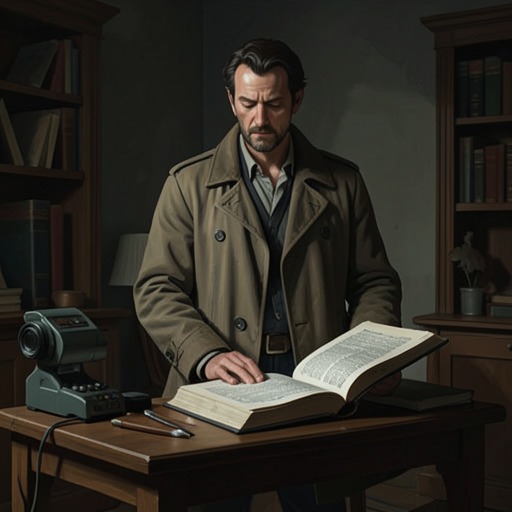
Cromwell keeps a pirated edition of Tyndale’s New Testament in a locked chest at Austin Friars. Printed in octavo on cheap paper, the Antwerp edition bears the mock imprint “PRINTED IN UTOPIA” where a printer’s address would ordinarily appear. The book’s modest, illicit material form contrasts with the authority claimed by church and state: a portable English text can be hidden, carried, read, and copied beyond the control of official institutions.
Cromwell offers Liz Wykys the key to the chest and urges her to read the book for herself, insisting that its being in English is precisely the point. She asks him to read it aloud instead, and he suspects that she has not understood what is absent from it. The exchange shows that access to a vernacular text does not automatically create a new reader; the book’s invitation must still meet the habits and beliefs of the household.
Tyndale’s work also reaches people at risk of discovery. During a search of John Petyt’s house, Petyt hides his Testament while his wife Lucy keeps Thomas More occupied. The search yields nothing, although More orders Petyt taken away. Lucy later describes her husband’s attempt to protect the book and the danger attached to possessing it. The English Testament is thus not only a theological argument but a physical object whose concealment can place its readers under suspicion and imprisonment.
Belief and Conscience
The novel associates Tyndale’s reforming doctrine with a direct relation between the believer and God. In Cromwell’s reflections, saints cannot secure salvation, prayers and candles cannot enlist them as helpers, and the Mass does not repeat Christ’s sacrifice. Priests need not stand between a person and God; salvation depends on the merits of the living Christ. These teachings challenge religious practices and intermediaries, not simply a disputed point of vocabulary.
Tyndale’s convictions also resist political accommodation. When Cromwell considers whether an English translation might receive royal approval, he knows that Tyndale will not support Henry’s divorce. Tyndale’s refusal places his scriptural mission at odds with the king’s immediate political purpose: the author will not trade a matter of principle for the protection or favor that might make his return possible.
Cromwell’s Negotiation for His Return
Cromwell tries to bring Tyndale home through a cautious negotiation involving Anne Boleyn, Henry VIII, and Stephen Vaughan, Cromwell’s contact in Antwerp. Anne has put Tyndale’s books into the king’s hands, and Cromwell explores whether Henry might permit a translation by a scholar he approves. The king has not expressly ruled out such permission, but neither has he authorized the translation already in circulation. Cromwell’s room for maneuver depends on keeping a possible future concession open without asking Henry to accept Tyndale’s work on Tyndale’s terms.
In spring, Vaughan arranges a meeting outside Antwerp, where Cromwell’s letter is delivered to Tyndale. Tyndale says he wants to come home, is tired of being hunted from city to city and house to house, and would accept the king’s choice of translator if only the people of England could hear the gospel in their own language. He says he would write no more and submit to whatever the king did to him. His offer makes the central demand plain: not personal safety or advancement, but access to scripture in English.
The negotiation does not succeed. As summer approaches, Cromwell judges that he has reached the limit of what he can risk: Henry is too hesitant, while Tyndale is too unyielding for the proposed compromise. Cromwell tells Vaughan to abandon the attempt, unwilling to sacrifice himself to Tyndale’s intransigence. The failure is not a simple rejection of vernacular scripture by the king; it arises from the collision between political caution, royal authority, and Tyndale’s refusal to endorse the king’s divorce.
Political and Narrative Significance
Tyndale’s claims sharpen the story’s wider conflict over competing authorities. His English Testament circulates through merchants, private chests, and concealed rooms, while churchmen and royal officials seek to regulate which books may be read. The text’s language makes scripture available beyond Latin-reading clergy, but that availability provokes searches, detention, and negotiations over who may authorize a translation.
Tyndale’s importance also appears in political arguments he does not personally deliver in the scenes. Cromwell’s conversations about the king’s authority over the English Church occur amid the reforming pressure created by vernacular scripture and evangelical readings. Yet Tyndale does not become a compliant instrument of royal policy: his refusal to validate Henry’s divorce exposes the difference between changing ecclesiastical jurisdiction and changing doctrine. His absence from the court does not lessen his influence; the forbidden book and the failed effort to bring its translator home keep his unyielding position in view.